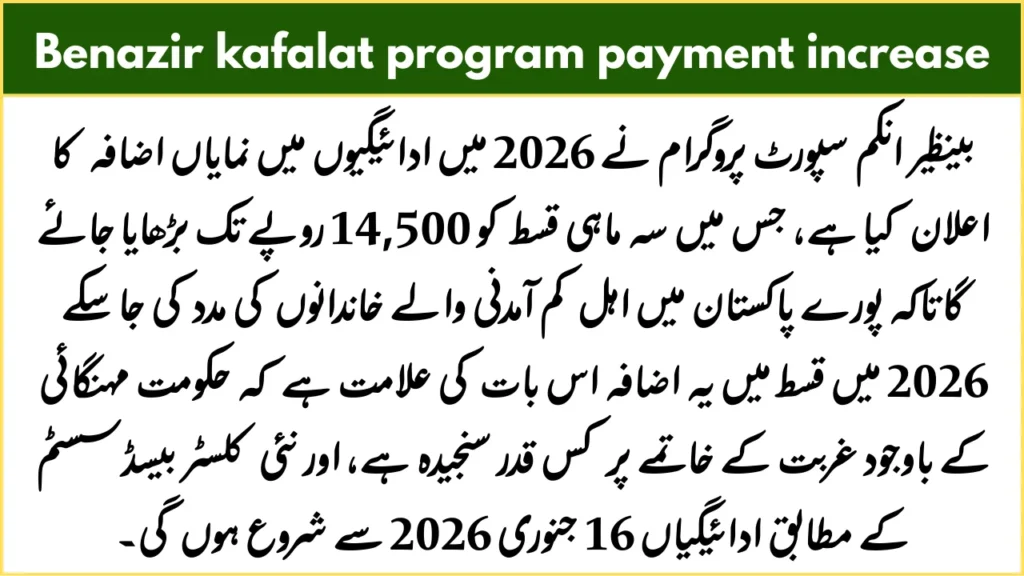
BISP Kafalat announced a considerable rise in 2026 BISP Kafalat payment increase, where quarterly stipends will be increased to Rs. 13,500 to help eligible low-income households throughout Pakistan. This BISP payment increase 2026 signifies how serious the government is about poverty alleviation despite high inflation, and the disbursements will commence on January 16, 2026, according to the new cluster based system upon the launch. Launched in 2008, the BISP Kafalat program aims to provide unconditional cash transfers to empower women from vulnerable households. The increase in BISP Kafalat payment has just been updated to ensure that over 9.3 million of these beneficiaries would now receive an enhanced transfer from Rs. 10,500 to Rs. 13,500 a quarter.
This development was introduced to respond to economic pressures and promote the financial inclusion of beneficiaries using digital channels. Payments have undergone scheduled changes under the BISP, with the recent enhancement of the Ehsaas Kafalat 2025 money designed as the building block for improvements in the coming 2026. The Benazir Kafalat program increased funds in 2025 to let the stipends counter inflation, which would continue into the BISP Kafalat 13500 increase, which comes into effect in early 2026. These are part of the national social protection objectives.
Announcement of BISP Kafalat Payment Increase 2026
Senator Rubina Khalid, BISP Chairperson, announced the increase in BISP in January 2026, with full implementation in 2026, which confirmed Rs. 13.500 quarterly from January 2025 onward. This BISP 2026 is for deserving women, which will roll out gradually for transparency purposes. The details of the BISP Kafalat were disseminated through authorized means such as the 8171 Portal. The core details of it specify that with this increase, Rs. 3000 will be added every quarter, increasing the total payout to a total of Rs. 13,500 for each family. Unlike previous years, this BISP quarterly in 2026 adopts a cluster distribution model via banks like HBL and JazzCash. Verification of recipient status is required using the SMS to 8171 method to facilitate seamless access.
Eligibility Criteria Set for BISP 8171 Payment
- Registration through the official 8171 web portal or SMS services the primary requirement to initial data submission for applicants seeking BISP benefits criteria for 2026.
- A valid Computerized National Identity Card (CNIC) will be a must, as this kind of identifier is most valuable in verification and preventing double claims under the BISP 8171 scheme.
- A poverty scorecard below 16.17 on the National Socio-Economic Registry (NSER) scale will automatically qualify a household under this. When scores are high, eligibility automatically falls.
- New household applicants must undergo Third-Party Verification and surveys by TEVTA (Technical Education and Vocational Training Authority) conduct field assessments of household assets, income sources, and living conditions for accurate profiling.
- Only verified profiles will gain access to the BISP to ensure that deserving women heads of low-income families benefit and to exclude those relatively well-off beneficiaries, such as salaried individuals, property owners, and pensioners, from the government.
- Families will be required to report any changes in their state, like owning vehicles or traveling to foreign countries, to maintain access to it, but have ongoing re-verification by NSER updates.
Distribution System of BISP payment 2026
Under the BISP the kafalat program aims to cluster-wise disbursement system has made a significant financial leap to enable the payments to the beneficiaries since its conception. The newly designed district wise cluster settlement system (DWCSS), launched by BISP and cluster partners like Easypaisa, HBL, and BOP, eliminates maladministration, which in the olden days slowed down the payment disbursal process. Under this system, districts are bunched together depending on where they are to be found, with Cluster representing parts of Punjab and perhaps Sindh. This is meant to be the most productive way of using resources with the shortest delay for beneficiaries, asopposed tot the ambiguous earlier staged line, for any district/every other memberin any district would stand in line for hours to receive a fraction of the payment. Being disbursed in a phased-out way by banks, disbursements can now take place, stretching across any part of Pakistan, namely, the most interior of KP or the far side of Balochistan. In a nutshell, this is how it is supposed to give while intensifying Kafalat increase into valuing a highly detribalized body of Pakistani informal economy.
BISP Kafalat Payment Increase January 2026 Schedule
- Programmed BISP Kafalat payments regarding the BISP January 2026 begin truly on January 16, 2026, for the first quarter in a free-for-all district-applicator environment across Pakistan.
- Counting globally, each district is to be clustered, consigning to each one a partner bank like HBL, Al-Falah Bank, and BOP, among others,s for logistics queens as beneficiaries begin to sidestep victimization, alighting on what theyperceive ase an unbearable wait.
- The method became the other way around, adjusting the schedule into several weeks, enabling Cluster 1 in respect of Punjab and Sindh to be flagged off whileClusters 2 to 5 would traverse their way to Khyber Pakhtunkhwa, Balochistan, and any other last places (proper clusters too, nevertheless) for effecting some kind of bulklok placement.
- Instead, partners in due course, everywhere like JazzCash andEasypaisa, have been allocated to parcelling up amongst clusters of districts respectively these collection processes are biometric and PayPak card-based, thus practically reducing queues and ccorruptionon probably at the same time. SMS are sent via helpline 8171 notifying the beneficiary about his/her cluster, the exact date on which payment is to be received, and details of the cluster collection posts in January 2026.
- By the early month of February 2026, the whole amount would have been disbursed, and in a better part to track in real-time in the 8171 portal by merely inputting the CNIC, aiming at making families comfortable to start planning their expenditures with the BISP update.

BISP Payment Increase for Beneficiaries
For very poor families with study (povertymark) scores below 16.17 under the National Socio-Economic Registry (NSER) database, BISP Kafalat payments increase beneficiaries represent more than 10 million families expected by 2026. This aspect is aimed at those marginalized in rural and urban areas in terms of widows, divorced, and low-income status, found in financial hardships. Reference to the BISP payment 2026 criterion is purely governed by the NSER data; therefore, no members are included who have a certain amount of money, those with of assets, or any who, even though they went for paid employment, should not have had it as a result; these harsh measures, then, cut down on fraudulent procurements. This measure is designed for the protection of a very vulnerable group and may well afford to empower women. Previous beneficiaries can automatically qualify for a so long as their status is still considered active. New entrants face due verification.
Role of 8171 Portal in Payment Updates
In line with the new BISP Kafalat system, payments related reports for 8171 have made for the following- all the more relevant for beginning status viewing to registered persons and confirming payment data for millions of users. Users may supply their CNIC to 8171 and instantly get responses on whether they are included, as well as on the scheduled payment date. With the Raast payment system attached, the payment system is now available locally, for instant banking transfers, making it easier for transactions to occur without the presence of cash, and developing the financial sector. Besides conventional inquiries, the portal maintains real-time tracking for every quarter installment, complaint lodging, and a live update on the 2026. Available 24/7 through web and SMS, this interactive platform further empowers users in Attock City and whatever is concerned within to remain informed without needing to visit our offices.
Verification Procedure for Beneficiaries
The eligibility of beneficiaries can be verified by messaging the CNIC to 8171, which will immediately confer on the beneficiary the status of increment under the payments. Linking up to Raast confirms direct credits. The resolution of disputes is through the BISP helplines.
Conclusion
This is a primary necessity within the BISP Kafalat payment increase 2026, which, from standards, raises all quarterly stipends to Rs. 13,500 for more than ten million deserving beneficiaries in Pakistan’s social protection framework. The upliftment aims to steer inflationary pressures along with empowering poor women in rural and urban areas, and to be distributed through a secure cluster system accessed via the 8171 portal. Enabling immediate household resilience, along with a cumulative foundation for sustained poverty reduction in the country, are priorities within the program and include transparency, biometric verification, and digital integration such as Raast.
FAQs
What exact the payment increase BISP Kafalat means?
Eligible families get per quarter Rs. 13,500 as a rise in the stipend amount – BISP payment increase 14500 compared to the earlier levels of Rs. 13,500.
When does the distribution for it in January 2026 commence?
Disbursements will begin on January 16, 2026, through phased rollout clusters across districts, with SMS alerts sent by 8171.
Who are the payments increase for?
Eligible beneficiaries are women’s households NSER according to the BISP 2026 standards, with poverty scorecard assessments lower than 16.17 and without significant assets, vehicles, or incomes.
What is the check facility through 8171?
Send CNIC via SMS to 8171 or visit the portal for instant updates on eligibility, schedules, and BISP payment increases through 8171.
Which banks are handling the distributions for the BISP in 2026?
Clusters assign partners such as Bank of Punjab, HBL, JazzCash, and Easypaisa to secure PayPak or biometric collections.
Will the BISP accept apply to new entrants?
New entrants will have to be registered through 8171, verify through TEVTA, and score low on the poverty scorecard to access the increase.

I created this Website to keep you updated with the latest news about the 8171 Ehsaas Program